
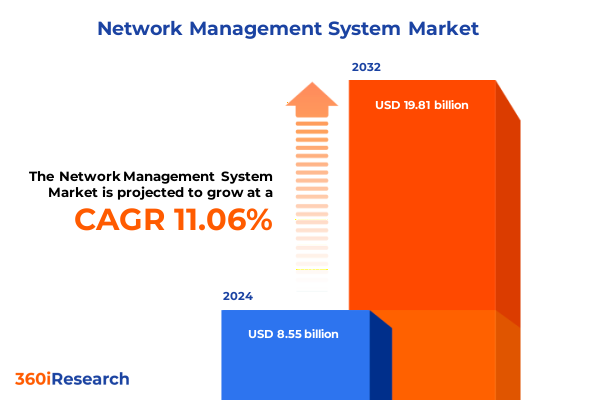
The Network Management System Market size was estimated at USD 8.55 billion in 2024 and expected to reach USD 9.47 billion in 2025, at a CAGR of 11.06% to reach USD 19.81 billion by 2032.
Unveiling the Fundamental Role and Strategic Importance of Modern Network Management Systems in Navigating Today's Rapid Digital Transformation Era
The complexity of modern enterprise networks has grown exponentially, driven by the convergence of cloud computing, edge environments, and the proliferation of connected devices. At the heart of this evolution lies the network management system, which serves as the nervous system for organizational digital infrastructure, orchestrating visibility, performance optimization, and security enforcement across distributed assets.
As enterprises embrace hybrid architectures blending on-premises, private cloud, and public cloud deployments, the demand for intelligent, scalable management solutions has never been greater. This introduction lays the groundwork for understanding how advanced network management capabilities are transitioning from operational support tools to strategic enablers that drive resilience, user experience, and competitive differentiation. By framing the current imperatives, we establish a clear foundation for the deeper analysis that follows.
Examining the Paradigm-Shifting Technological and Operational Transformations Redefining Network Management in an Era of Cloud, AI, and Edge Computing
The network management landscape is undergoing a series of paradigm-shifting transformations that transcend incremental upgrades. Artificial intelligence and machine learning are being infused into operational workflows to enable predictive analytics, anomaly detection, and automated root cause analysis, which vastly reduce mean time to resolution and proactively guard against performance degradation.
Simultaneously, edge computing has emerged as a critical frontier, decentralizing processing power and demanding distributed management architectures that can handle intermittent connectivity and localized policy enforcement. Furthermore, security imperatives have catalyzed innovations in zero trust frameworks and Security Orchestration, Automation, and Response (SOAR), compelling network management platforms to integrate threat intelligence seamlessly with performance and configuration modules. These converging currents are redefining expectations for agility, control, and holistic visibility in network operations.
Assessing the Multifaceted Effects of 2025 United States Tariff Adjustments on Network Management Systems Across Sectors and Value Chains
In 2025, adjustments to United States tariff policies have introduced new layers of complexity for organizations procuring network hardware and related technologies. Elevated duties on select semiconductor components and network equipment have driven procurement teams to reassess sourcing strategies, shifting focus toward software-defined architectures that can mitigate hardware cost volatility.
These tariff-induced pressures have further accelerated supply chain diversification initiatives, including nearshoring and alternative manufacturing partnerships, to reduce exposure to import levies. At the same time, procurement roadmaps are increasingly factoring in total cost of ownership metrics, emphasizing modular, upgradeable hardware that can adapt to evolving tariff landscapes. The ripple effects are also visible in vendor roadmaps, as manufacturers realign production priorities and emphasize cloud-based virtual appliances to circumvent hardware tariff impacts.
Illuminating Critical Market Segmentation Dynamics Across Components, Organizational Scale, Deployment Modalities, and End-User Verticals
A holistic understanding of network management dynamics emerges when viewing market segmentation through the lens of functional components such as configuration management, event management, fault management, performance management, and security management. Security management has gained prominence as organizations prioritize threat mitigation, while performance management remains integral to ensuring service-level adherence. Meanwhile, configuration and fault modules are converging with event management platforms to create unified operational consoles that streamline troubleshooting and change validation.
When examining organizational scale, large enterprises are leveraging full-stack suites to manage intricate, multi-national networks, whereas smaller enterprises and medium-sized businesses are opting for modular offerings that can scale cost-effectively. Deployment type further nuances the picture: public cloud instances are favored for their rapid scalability and low upfront capital expenditure, while private cloud solutions retain appeal for highly regulated environments. End users across Banking and Insurance verticals demand rigorous security and compliance features, Federal and State agencies emphasize audit-ready performance reporting, clinics and hospitals prioritize interoperability and uptime, e-commerce retailers focus on real-time transaction monitoring, and telecom and IT providers seek elastic architectures capable of supporting expanding user bases.
This comprehensive research report categorizes the Network Management System market into clearly defined segments, providing a detailed analysis of emerging trends and precise revenue forecasts to support strategic decision-making.
- Offering
- Network Type
- Applications
- Deployment Type
- Organization Size
- End User
Deciphering Regional Dynamics and Growth Drivers Influencing Network Management Adoption Across Americas, EMEA, and Asia-Pacific Ecosystems
Regional ecosystems offer distinct drivers for network management adoption. In the Americas, hybrid infrastructures that blend on-premises clusters with public cloud environments are redefining operational paradigms, prompting investments in orchestration tools that bridge disparate platforms. Regulatory frameworks such as data sovereignty mandates are shaping deployment blueprints, while a robust innovation culture fuels early adoption of AI-driven analytics across network operations.
In Europe, the Middle East and Africa, stringent data privacy regulations and cyber resilience directives are elevating the role of security management modules, with organizations placing a premium on platforms that embed encryption, identity governance, and real-time threat intelligence. Asia-Pacific markets display a surge in 5G rollouts and edge computing initiatives, leveraging rapid growth in manufacturing automation, smart city deployments, and IoT ecosystems. This diverse regional tapestry underscores the necessity for vendors and implementers to align solution roadmaps with localized needs and compliance landscapes.
This comprehensive research report examines key regions that drive the evolution of the Network Management System market, offering deep insights into regional trends, growth factors, and industry developments that are influencing market performance.
- Americas
- Europe, Middle East & Africa
- Asia-Pacific
Profiling Leading Innovators and Strategic Collaborators Shaping the Future of Network Management Solutions Through Technological Leadership and Partnerships
Leading technology integrators and specialist developers are shaping the network management arena through a combination of organic innovation and strategic alliances. One prominent player has integrated intent-based networking capabilities to translate high-level policies into real-time configurations, while another has embedded robust AI operations functionality to correlate performance metrics with predictive incident prevention.
Partnerships between established infrastructure vendors and boutique software specialists are creating modular ecosystems that allow customers to assemble best-of-breed management consoles. Meanwhile, cloud-native entrants are challenging legacy paradigms by offering lightweight virtual appliances that can be deployed across multi-cloud landscapes. These competitive dynamics reflect a market in which technological leadership hinges on both depth of functional coverage and agility in responding to customer demands for seamless interoperability and automation.
This comprehensive research report delivers an in-depth overview of the principal market players in the Network Management System market, evaluating their market share, strategic initiatives, and competitive positioning to illuminate the factors shaping the competitive landscape.
- Amazon Web Services, Inc.
- Auvik Networks Inc.
- BlueCat Networks, Inc.
- Broadcom Inc.
- Cisco Systems, Inc.
- Cloudflare, Inc.
- Colasoft
- Cubro Network Visibility
- Datadog, Inc.
- Dorado Software, Inc.
- Dynatrace LLC.
- ExtraHop Networks, Inc.
- Google LLC by Alphabet Inc.
- Hewlett Packard Enterprise Company
- Huawei Technologies Co., Ltd.
- Icinga GmbH
- International Business Machines Corporation
- Kentik Technologies, Inc.
- LiveAction, Inc.
- Microsoft Corporation
- Nagios Enterprises, LLC
- NetScout Systems, Inc.
- Nexog Ltd
- NinjaOne, LLC
- Nokia Corporation
- Open Text Corperation
- Oracle Corporation
- Paessler GmbH
- Progress Software Corporation
- Riverbed Technology, Inc.
- Siemens AG
- SolarWinds Worldwide, LLC.
- Telefonaktiebolaget LM Ericsson
- Viavi Solutions Inc
- Zoho Corporation Pvt. Ltd.
Implementing Adaptive Strategies and Proactive Frameworks to Maximize Operational Efficiency and Resilience in Network Management Amidst Evolving Challenges
Industry leaders should prioritize the integration of AI-driven automation into routine workflows, enabling predictive maintenance and intelligent anomaly resolution that preempt outages before they impact end users. This requires a commitment to data governance frameworks that ensure the integrity of training datasets, as well as cross-functional teams that bridge network operations and data science expertise.
Simultaneously, adopting zero trust security architectures will safeguard perimeter environments and protect distributed edge nodes, reinforcing resilience against sophisticated threat vectors. Supply chain diversification strategies, including nearshore manufacturing and alternative component sourcing, are essential to mitigate tariff-related cost fluctuations. Leadership teams must also champion cloud-native migration initiatives, phasing out monolithic appliances in favor of containerized network functions that can be orchestrated seamlessly across hybrid deployments.
Detailing Rigorous Methodological Frameworks and Analytical Approaches Employed to Ensure Comprehensive and Objective Evaluation of Network Management Trends
This research draws upon a rigorous blend of secondary research and primary data collection to deliver comprehensive market insights. The secondary phase encompassed a systematic review of vendor whitepapers, industry journals, and regulatory filings to establish a foundational understanding of network management trends and tariff developments. Concurrently, publicly available data on procurement patterns and technology roadmaps was analyzed to validate evolving adoption curves.
The primary research phase involved structured interviews with chief information officers, network architects, and procurement leaders across diverse industries and regions. A Delphi panel of subject matter experts provided iterative feedback on preliminary findings, ensuring that the analysis reflects both quantitative metrics and qualitative nuances. Data triangulation techniques were employed to reconcile discrepancies across sources, while case study validations were conducted with select enterprise deployments to confirm practical applicability of the insights presented.
This section provides a structured overview of the report, outlining key chapters and topics covered for easy reference in our Network Management System market comprehensive research report.
- Preface
- Research Methodology
- Executive Summary
- Market Overview
- Market Insights
- Cumulative Impact of United States Tariffs 2025
- Cumulative Impact of Artificial Intelligence 2025
- Network Management System Market, by Offering
- Network Management System Market, by Network Type
- Network Management System Market, by Applications
- Network Management System Market, by Deployment Type
- Network Management System Market, by Organization Size
- Network Management System Market, by End User
- Network Management System Market, by Region
- Network Management System Market, by Group
- Network Management System Market, by Country
- United States Network Management System Market
- China Network Management System Market
- Competitive Landscape
- List of Figures [Total: 18]
- List of Tables [Total: 1590 ]
Summarizing Core Findings and Strategic Imperatives to Navigate Future Network Management Challenges and Capitalize on Emerging Technological Opportunities
The modern network management landscape is characterized by rapid technological convergence, shifting regulatory sands, and evolving procurement strategies influenced by tariff adjustments. Organizations that harness AI-enabled automation, embrace zero trust security paradigms, and adopt modular, cloud-native architectures will be best positioned to achieve operational excellence.
Tailoring solutions to specific organizational scales, deployment preferences, and industry vertical requirements is critical. Regional nuances-from sovereignty regulations in the Americas to privacy mandates in EMEA and 5G-driven edge deployments in Asia-Pacific-must inform strategic roadmaps. By synthesizing these insights, decision-makers can navigate complexity, bolster resilience, and capture emerging opportunities in network management.
Unlock Comprehensive Network Management Insights Today by Partnering with Ketan Rohom to Propel Your Organizational Strategy with Expert Research Guidance
I invite you to connect with Ketan Rohom, Associate Director of Sales & Marketing, to secure immediate access to the comprehensive network management system research report tailored to your strategic needs. Engage today to gain actionable insights that will empower your organization’s digital transformation journey and fortify your network operations against emerging complexities and competitive pressures.

- How big is the Network Management System Market?
- What is the Network Management System Market growth?
- When do I get the report?
- In what format does this report get delivered to me?
- How long has 360iResearch been around?
- What if I have a question about your reports?
- Can I share this report with my team?
- Can I use your research in my presentation?


